
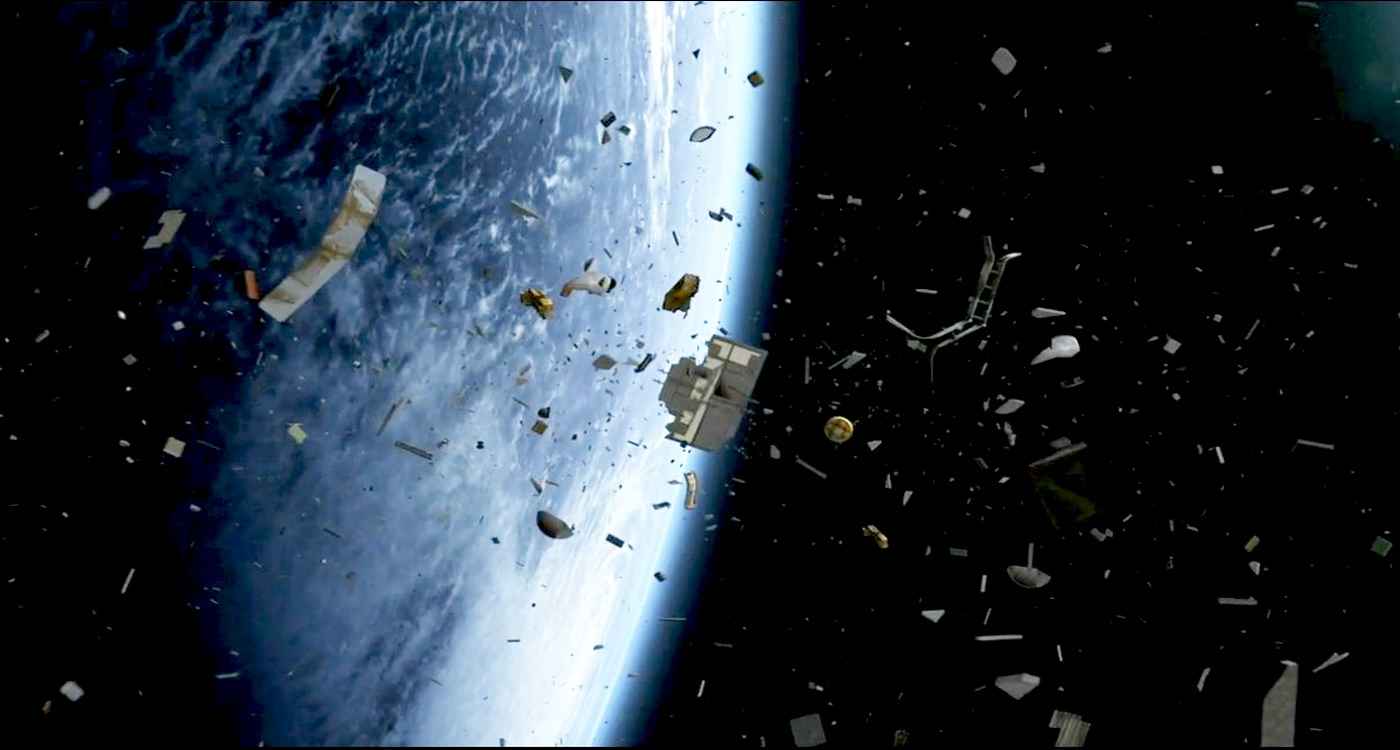
A Chinese satellite has broken apart in orbit and left at least 43 trackable pieces behind. The US Space Force’s 18th Space Defense Squadron has already catalogued all of them. Yaogan-50 (02) launched in March, and the cause of the breakup is still unknown, SpaceNews reports.
The fragments spread across orbits between roughly 600 and 1,100 km. They kept the satellite’s distinctive 142-degree inclination. A propulsion or battery failure is one possible cause. A collision with another object or a piece of debris is another.
At that altitude the atmosphere provides almost no drag. The new fragments will likely stay up for decades or longer, and each one is a hazard to working spacecraft.
Yaogan-50 (02) went up on a Long March 6A rocket from the Taiyuan launch centre on March 15. The first satellite of the pair, Yaogan-50 (01), had taken the same path two months earlier. Both used a rare, steeply retrograde orbit — one where the spacecraft travels against the Earth’s rotation.
Follow Mediasat on Google News: the latest in TV, telecom and tech
That costs extra energy at launch and cuts into the rocket’s payload. In return, the satellite moves faster relative to the ground below. It gets more frequent looks at mid-latitudes, including China itself and the regions around it. Israel is about the only other country that uses such orbits regularly, mostly because of where it can safely launch.
Officially, Chinese aerospace corporation CASC describes the Yaogan series as Earth observation satellites, listing crop assessment and disaster response among their jobs. Western analysts believe some of them fly reconnaissance missions instead, carrying radar, optical systems and signals intelligence gear. Yaogan-50 (01) was built by the Shanghai Academy of Spaceflight Technology, the second satellite by the China Academy of Space Technology.
China has not publicly commented on the breakup. Its own space object catalogue, Spacemapper, already lists four fragments tied to the satellite — so Chinese sensors have seen the event too.
Space debris stopped being a story about individual accidents long ago. The single worst event remains China’s 2007 anti-satellite weapon test, which destroyed the Fengyun-1C satellite. Nineteen years later, 2,318 pieces of it are still being tracked.
About 54,000 objects larger than 10 cm are currently tracked in orbit, and only around 9,300 of them are working spacecraft. Smaller pieces vastly outnumber those. Roughly 1.2 million objects measure between 1 and 10 cm, and about 140 million particles fall between 1 mm and 1 cm.
Most of that population cannot be catalogued at all, which does not make it any safer. At orbital speeds even a small fragment can cripple a satellite or knock it out entirely. The same risk has already been weighed for Starlink, whose satellites could be threatened by debris from a Chinese Long March 6C rocket.
